Why Your Children Need Progress, Not Perfection
posted on Jun 17, 2026
Gurukul The School, recognised as the best school in Ghaziabad, we believe that every student undergoes a journey of steady progress that leads them to lasting success.
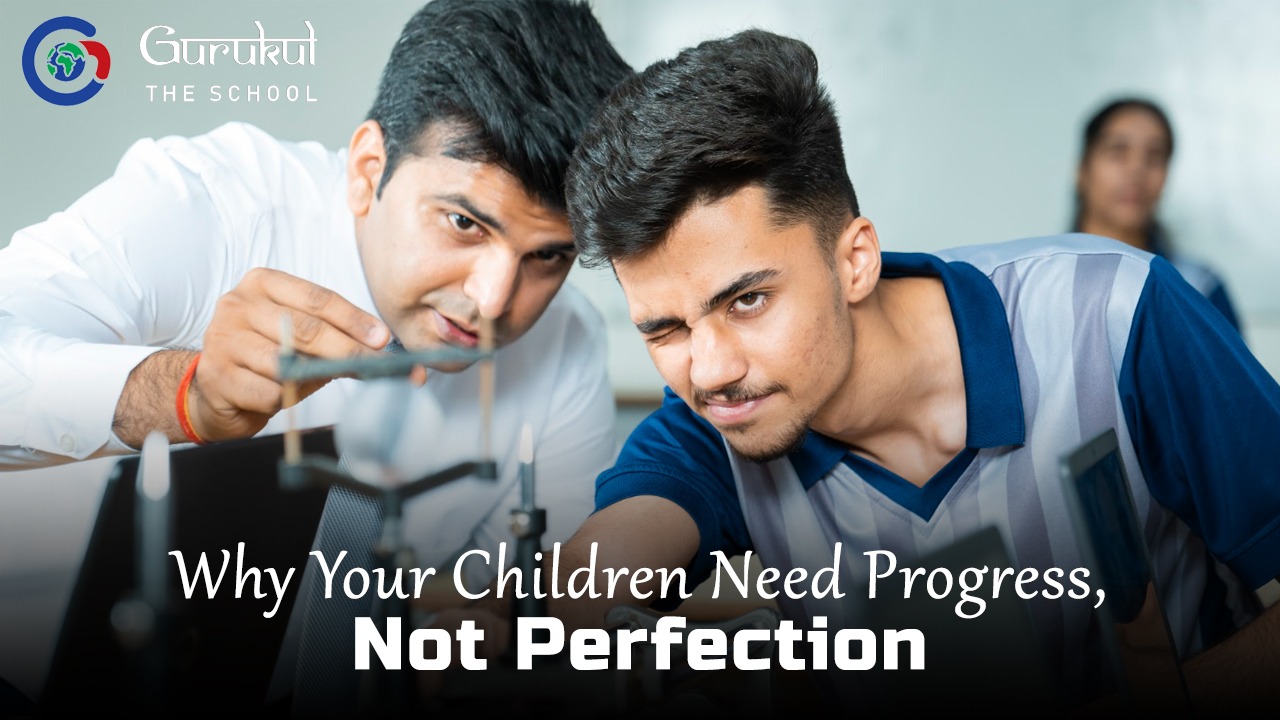
Many people have a habit of measuring children’s growth using report cards, grades, and medals because they’re the most visible signs of success. If a student’s report card reflects straight A’s or the child has consistently earned the first position in competitions, then they’re considered successful. However, what people fail to notice is how children reached those milestones.
At Gurukul The School, recognised as the best school in Ghaziabad, we believe that every student undergoes a journey of steady progress that leads them to lasting success. If you push kids to become ‘perfect’ at everything they do, they might start feeling disassociated from the learning journey itself and become overly focused on outcomes alone.
This isn’t a good approach if you want your kids to grow sustainably and holistically. The following points will help you understand why your children need progress, not perfection, so ensure you read till the end.
If children somehow begin to believe that whatever tests, assignments, or activities they are doing have to be nothing less than perfect, they’ll obviously become more concerned with avoiding mistakes than with understanding concepts. Over time, they’ll start equating success with being right, and this is exactly when it turns into a problem.
Hence, at Gurukul The School, we encourage our students to develop a progress-focused mindset because it teaches them that every attempt, successful or not, is a part of the learning process.
This understanding makes them more open to asking questions, experimenting with new ideas, and accepting feedback for continued growth. These behaviours are exactly what will lead to stronger academic performance and deeper understanding than chasing perfect scores on every task.
It’s a known fact that children can improve when they attempt things they cannot do yet. For some children, it can be about solving a difficult maths problem, while it can be about speaking on stage for another student. Regardless of the activity, progress will always come through repeated practice, mistakes, and gradual refinement.
If children start fearing imperfection, they’ll gradually start avoiding challenges, sticking to what feels safe. It can limit their growth, both academic and personal. Hence, the focus should always be on steady progress, not perfection.
You must have heard that people often become confident after becoming successful. According to Gurukul The School, it isn’t true for everyone. We’ve held conversations with numerous students and found that students with lasting confidence have an exceptional record of sustained personal progress. From our perspective, a child who struggles, practices consistently, and eventually succeeds develops genuine self-belief because they understand they’ve earned the outcome.
But if a child is praised only for perfect results, they may begin doubting themselves whenever they face a setback. They may start worrying that one mistake can define their ability.
Hence, every parent should teach their children to focus more on progress and less on perfection. It will teach children that they can overcome difficulties through effort, making their confidence more stable and less dependent on external validation.
Once children grow up and step beyond the boundaries of their school life, they’ll notice that success rarely depends on never making mistakes. Ask any successful entrepreneur, artist, or innovator around you, and you’ll realise none of them was perfect throughout their journey. They explored their path, made mistakes, refined their work after learning from mistakes, and based on these do’s and don’ts that life taught them, they continued making steady progress thereafter.
This is what leads to extraordinary success. Regardless of the profession or career field your child wants to pursue, they’ll have to undergo a similar path to become successful. Hence, it’s wiser to push them towards a progress-oriented mindset rather than expecting them to become perfectionists.
Frequently Asked Questions (FAQs)
Yes, they can. You can expect continued efforts and gradual improvement in academics from your children without having the desire for perfection.
By practising simple things at home, such as praising effort instead of results, celebrating improvement, and focusing more on learning than on outcomes, parents can easily develop a progress mindset in their children.
Yes, it does. Children with a progress mindset are generally more confident and have better problem-solving abilities. This helps them a lot in real-world situations.
Conclusion
Learning is a continuous process that never remains limited to schools. Even after your child finishes their formal learning journey and enters their professional life, they’ll still have to learn new skills as and when their work demands them. They can only navigate it if they’ve been taught to focus on progress over perfection from their school days.
We at Gurukul The School, regarded as the best school in Ghaziabad, recognise the importance of a progress-based mindset, which is why we encourage all our students to develop it. We have also designed our pedagogy in a way that, along with growing academically, our students also get to hone their life skills and experience 360-degree growth.
While we at our school are actively doing whatever it takes towards the holistic development of children, we urge parents to also try and make small efforts at home, like organising a 21-day challenge to learn a new concept or arranging competitions where the focus is on finishing the task, not on perfecting the activity. Trust us, these combined efforts will work wonders in significantly benefiting your children.